
'/%3E%3C/svg%3E)


Arriving in Madeira often creates the strange impression of having crossed several continents without ever setting foot beyond one island.
On this small volcanic fragment floating in the Atlantic, landscapes seem to have been arranged by a geologist with a wonderfully unpredictable imagination. A morning may begin in the damp silence of the forest, among trees wrapped in moss and ancient paths following the course of the levadas — those remarkable irrigation channels that have carried water across the mountains for centuries.
A few hours later, after walking beneath a canopy of vegetation that appears to belong to another age, one may find oneself facing the Atlantic, bathing in a natural pool carved from black volcanic rock. Few places in Europe have such a talent for changing their character so abruptly.
And yet Madeira is still frequently introduced through two famous names: Cristiano Ronaldo, born in Funchal, and the wine that has made the island’s name famous around the world. Both are part of Madeira’s identity, naturally, but they are rather like the front cover of a much older and far more intriguing book.
To understand Madeira, one must look beyond its most familiar symbols: following the channels carved into the mountains by generations of islanders, entering the laurissilva — a primeval forest that preserves a fragment of an ancient European landscape and is now recognised as a UNESCO World Heritage Site — and observing how a volcanic island once considered harsh and inhospitable was patiently transformed into a place where gardens, vineyards and villages could flourish.
What makes Madeira fascinating is this constant conversation between nature and human ingenuity. The island is a record of negotiation: between mountains and farmers, between water and stone, between a restless geological past and the determined hands of those who chose to live here.
But what should you see in Madeira? Which places reveal the true character of the island?
In these pages, I will take you to the places that tell Madeira’s story most vividly: ancient forests, volcanic pools, villages suspended between mountains and sea, extraordinary gardens, dramatic landscapes shaped by fire and wind, and paths that have followed the movement of water across the island for generations.
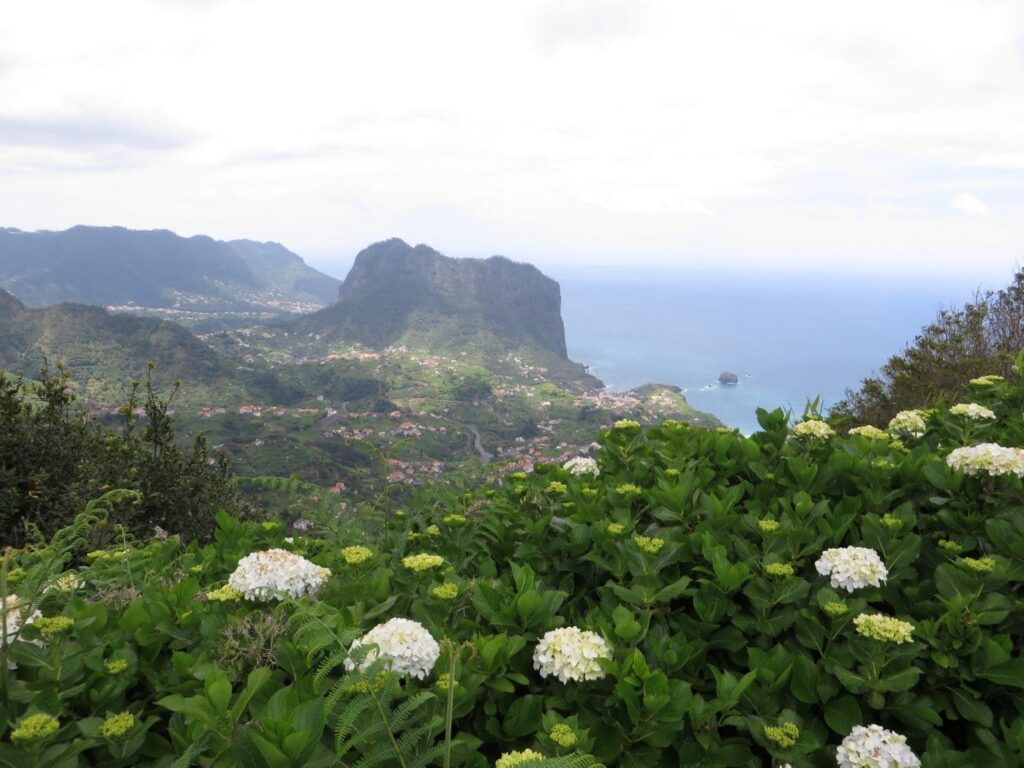
Madeira is known as the “Garden Island”
Article contents
- Madeira, the island born from fire and shaped by water
- Funchal: the city overlooking the ocean
- Monte: Funchal’s hillside world of devotion, gardens and traditions
- Monte Palace Tropical Garden: a botanical collection above Funchal
- Porto Moniz and Madeira’s natural pools
- Madeira’s levadas: walking alongside the course of water
- Madeira’s Laurissilva: an ancient forest that survived through time
- Ponta de São Lourenço: Madeira shaped by the wind
- Madeira’s villages between sea and mountain
- When to visit Madeira and how many days you need
- Practical advice for visiting Madeira
Madeira, the island born from fire and shaped by water
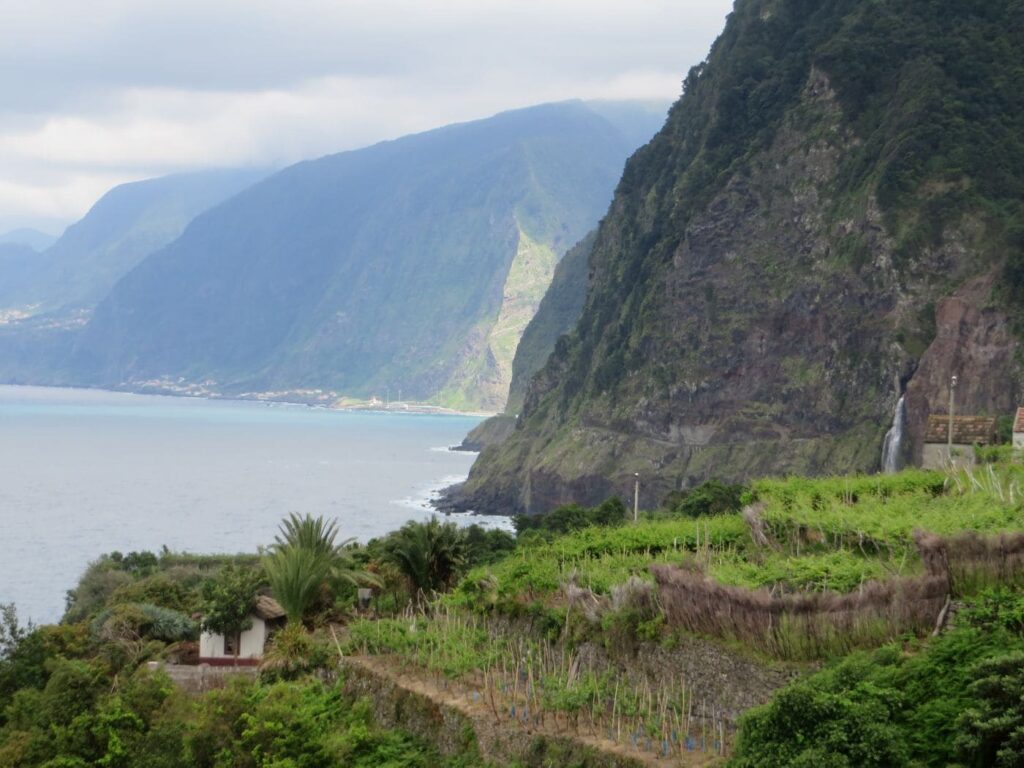
The coast of Seixal in Madeira
Before deciding what to see in Madeira, it is worth understanding the force that shaped it. The island’s beauty comes from an unlikely partnership: volcanic fire, the constant presence of the Atlantic, and generations of inhabitants who learned how to live with a landscape that was magnificent, but hardly generous.
Set in the eastern Atlantic, around 600 kilometres from the coast of Morocco and just over 900 kilometres from mainland Portugal, Madeira belongs to the Macaronesian archipelagos — a region especially prized by botanists for its extraordinary natural heritage.
On a map, Madeira appears almost modest: a small green speck surrounded by an enormous blue expanse. Yet walking across it reveals a surprising concentration of landscapes. Mountains rising above 1,800 metres, deep valleys, cliffs dropping dramatically into the sea, mist-covered forests and villages built on slopes where every terrace represents a small victory over gravity.
Madeira: Portuguese in culture, subtropical in nature
The name itself reveals something of the island’s history. When the Portuguese navigators João Gonçalves Zarco and Tristão Vaz Teixeira arrived here in 1420, they called it Madeira — “wood” in Portuguese — because of the dense forests that covered the territory.
The centuries that followed witnessed a long, and not always gentle, conversation between human ambition and the natural world. To create agricultural land, vast areas of woodland were cleared and burned; at the same time, the inhabitants developed ingenious ways of adapting to an environment defined by steep slopes and limited space.
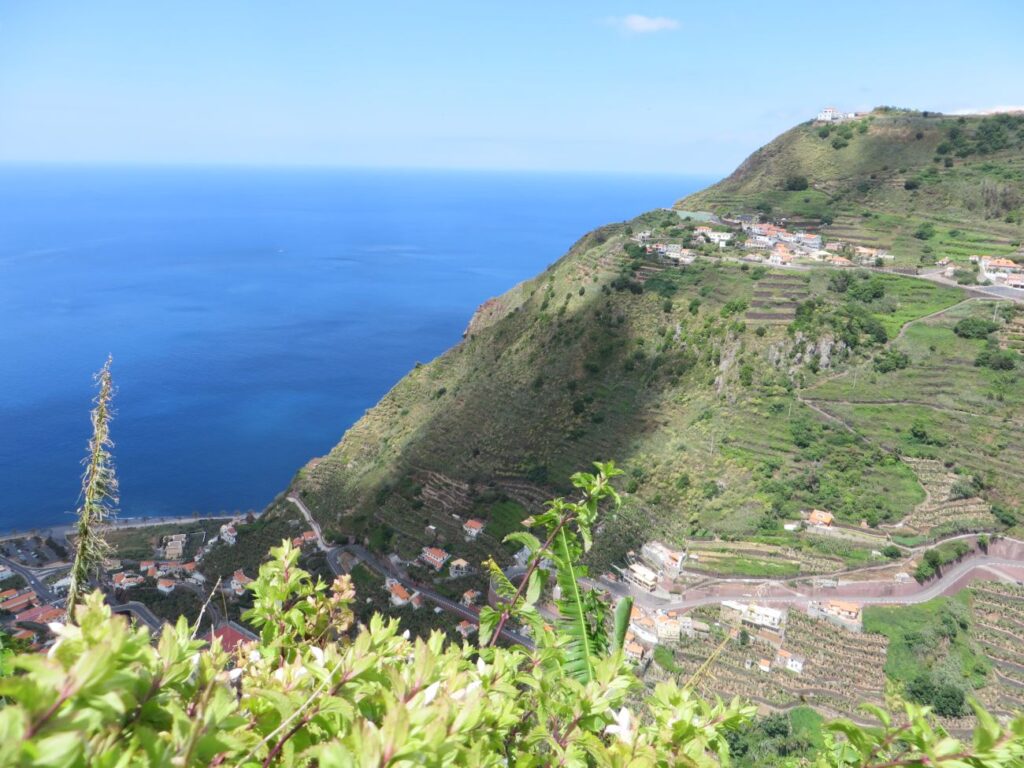
They built terraces into the mountainsides, created irrigation systems that still cross the island today, and transformed seemingly inhospitable ground into vineyards, gardens and cultivated fields.
In Madeira, nature never appears entirely separate from human presence. The forest grows beside paths shaped by generations of walkers; water flows through channels carved into volcanic rock; villages seem to cling to the mountains rather than conquer them.
The most remarkable expression of this natural inheritance is the laurissilva forest, an ancient subtropical ecosystem whose origins date back millions of years and which is now recognised as a UNESCO World Heritage Site.
The best way to understand it is to walk through it. Inside the laurissilva, the forest gradually closes around the path: moss covers the trunks, ferns fill the undergrowth, and water becomes a constant, quiet companion, almost inseparable from the woodland itself.
And it is by following the journey of water that one discovers one of Madeira’s most distinctive features: the levadas, the historic irrigation channels that have become pathways leading travellers into the island’s hidden interior.
What to see in Funchal: the city overlooking the Atlantic
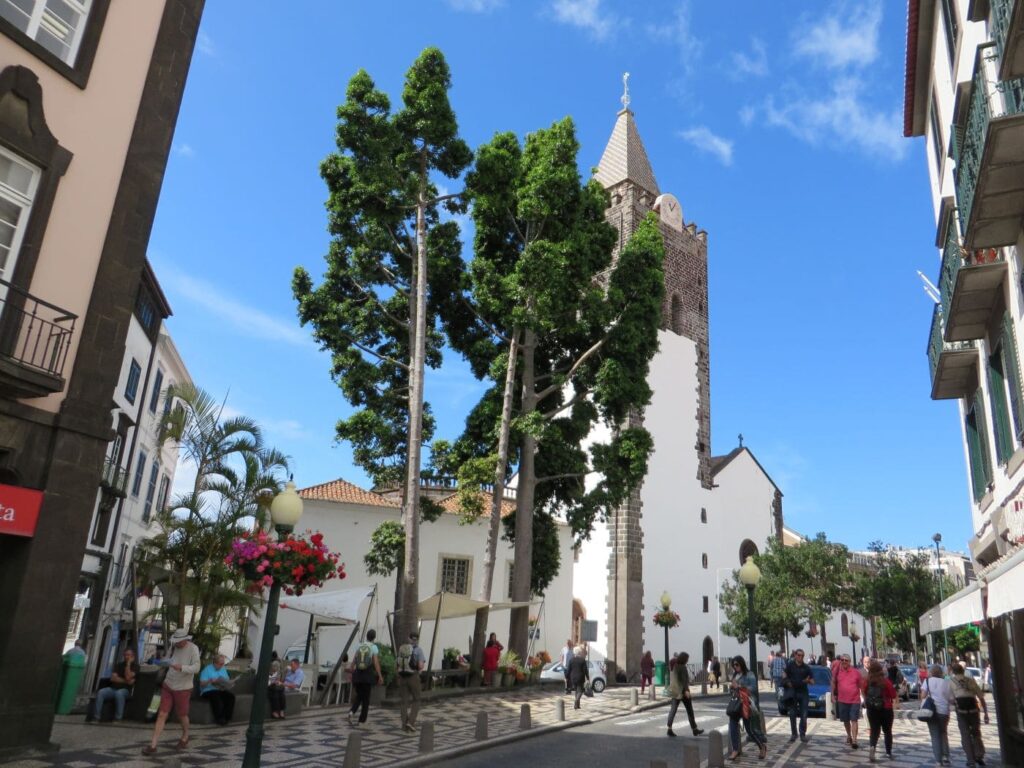
Funchal Cathedral (Sé)
Funchal has much in common with other Portuguese cities. There are streets paved with calçada portuguesa, white-fronted churches, wrought-iron balconies and houses decorated with azulejos. Yet the resemblance becomes rather less convincing as soon as one looks at what is growing beside them.
Palms, strelitzias, jacarandas and banana plants thrive here, species that would struggle to find quite the same welcome in mainland Portugal. In gardens and along the streets, the boundary between the city and its subtropical surroundings becomes remarkably difficult to draw. Funchal may have been built by the Portuguese, but its geography has always had ideas of its own. It is a city born beside the ocean and shaped by centuries of looking towards distant shores.
Funchal Cathedral: a church born in the Age of Exploration
In the heart of Funchal’s historic centre stands the Sé, built between the late fifteenth and early sixteenth centuries, when Portugal was busy turning the Atlantic from the edge of the known world into an extraordinarily profitable network of routes.
Inside, attention is inevitably drawn upwards. The cedarwood ceiling is one of the cathedral’s great treasures, its intricate decoration preserving something of the visual language of the Manueline age. This was a period in which faith, wealth and political ambition travelled remarkably well together, usually aboard Portuguese ships heading towards lands about which Europe possessed a great deal of curiosity and considerably less reliable information.
After all this empire, navigation and ecclesiastical splendour, Funchal provided me with a rather less elevated historical encounter. I found Sissi.
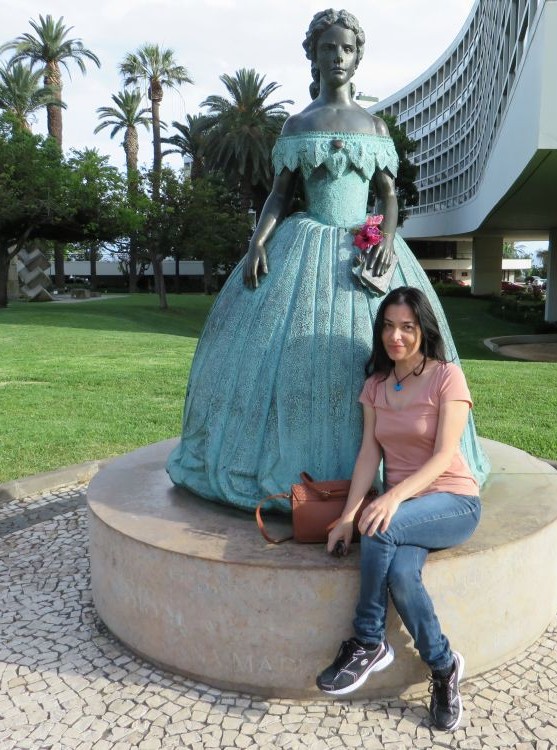
Or, more accurately, I found a statue of Empress Elisabeth of Austria and promptly did what generations of otherwise sensible travellers have done in the presence of a famous bronze figure: I stood beside her and had my photograph taken.
Vila Velha and Rua de Santa Maria: painted doors and everyday life
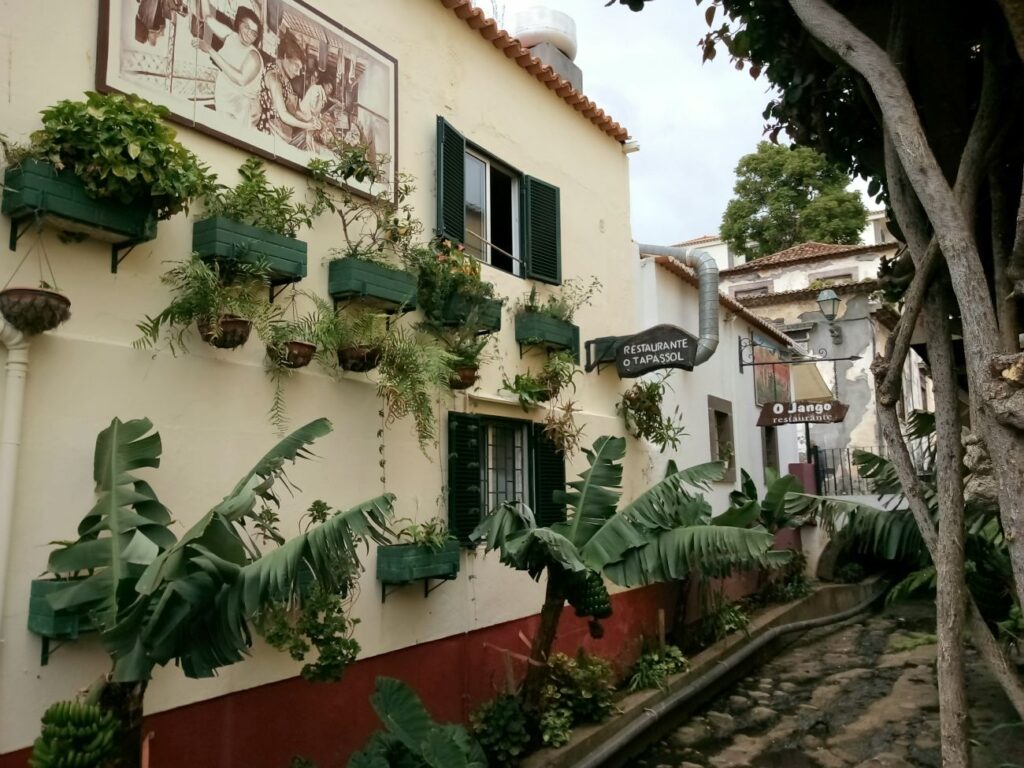
Walking down towards the sea brings you to Vila Velha, the oldest part of Funchal, where the city changes scale. Grand façades give way to narrower streets, restaurants occupy old houses, and front doors open almost directly onto the life of the street.
Rua de Santa Maria is best known for its painted doors, the result of an artistic project that invited numerous artists to turn old and often neglected entrances into works of art. What makes it interesting is that nobody attempted to manufacture an open-air museum from scratch. The artists worked with what was already there: doors belonging to houses, shops and buildings that remained part of the neighbourhood’s everyday life.
Mercado dos Lavradores: Madeira’s daily theatre of food
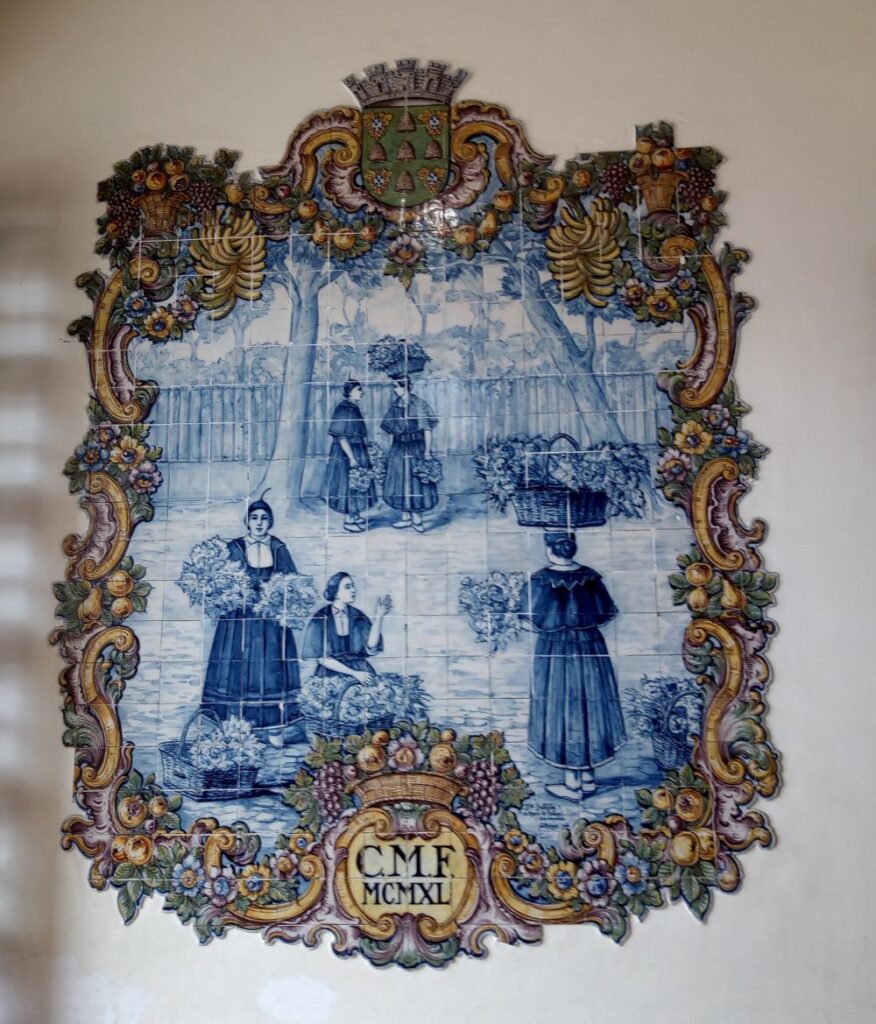
To understand Madeira’s relationship with what it grows, catches and eats, one should spend some time at the Mercado dos Lavradores. Opened in the 1930s, the market occupies a Modernist building decorated with traditional azulejos, an architectural combination that sounds rather more improbable than it looks.
Its stalls are piled with tropical fruit, flowers, fish and local specialities, and together they offer a remarkably concise lesson in Madeira’s geography. This is Portugal, certainly, but Portugal transformed by an Atlantic climate, centuries of maritime exchange and crops introduced from elsewhere and gradually absorbed into island life.
The vendors are exceptionally accomplished at offering samples. A slice of papaya appears; then a tropical fruit you may never have encountered before; then something else whose origins, virtues and remarkable flavour are explained with considerable enthusiasm. The dangerous part is that much of it really is very good.
The more delicate moment comes when enthusiasm turns into commerce. Two papayas, a custard apple, perhaps another exotic fruit or two: nothing that appears likely to require serious financial planning. Then comes the bill.
At this point, it is perfectly reasonable to inspect the contents of the bag once again, partly to make sure that no truffles, caviar or small pieces of jewellery have somehow slipped in among the fruit. Prices at some stalls can be surprisingly high, so there is one useful rule worth remembering: always ask the price before buying.
Curiously, however, my most persistent memories of Madeira’s food did not come from the famous market at all, but from the padaria beneath my flat. I had chosen to stay in the centre of Funchal, and every morning I had only to open the door for the smell of freshly baked pastries to interfere with whatever sensible plans I had made for breakfast.
The bakery was downstairs: a few steps, a window crowded with local specialities and, each morning, the firm intention of trying just one. It was an admirable principle. It lasted approximately until I reached the counter.
Monte: above Funchal, between devotion, tropical gardens and old traditions
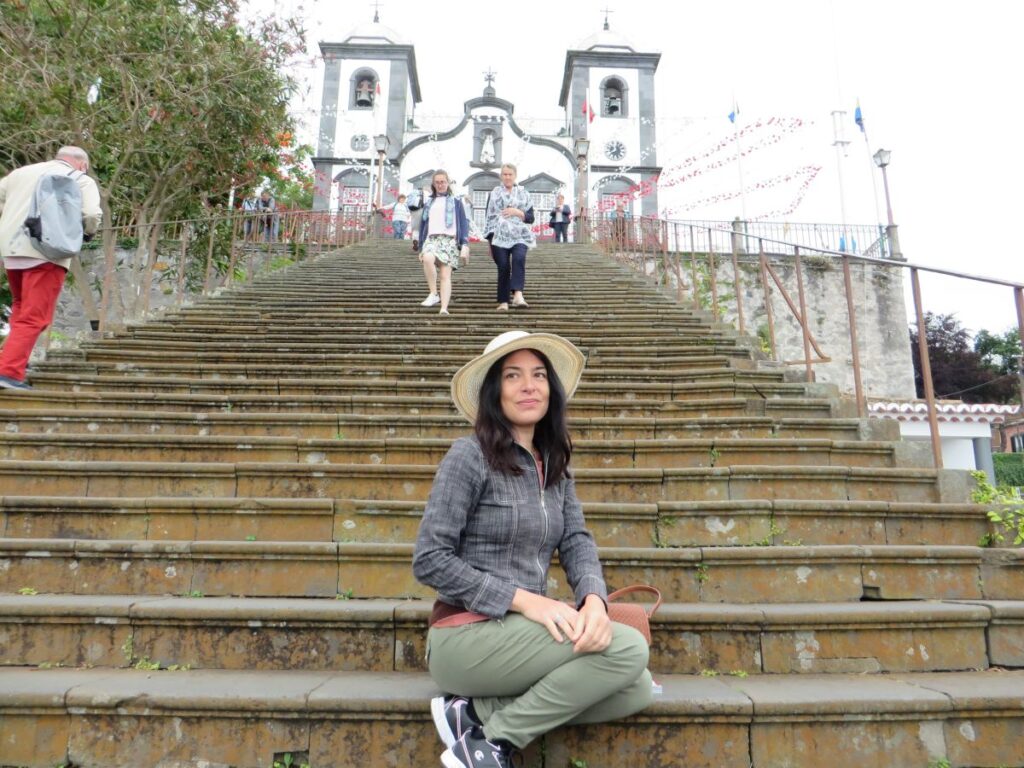
Leaving central Funchal and following the road into the hills, one quickly discovers one of Madeira’s more remarkable geographical habits: the island has very little interest in putting a respectable distance between the sea and the mountains. Within a few kilometres, the Atlantic has fallen away below and the landscape has changed altogether.
Nossa Senhora do Monte: Madeira’s most important sanctuary
At an altitude of around 600 metres lies Monte, a small hillside settlement gathered around the church of Nossa Senhora do Monte, the island’s principal place of pilgrimage.
The present church stands on the site of an earlier fifteenth-century chapel and remains an important centre of devotion, particularly during the celebrations of 14 and 15 August, when pilgrims and visitors make their way up to Monte. Here, devotion extends well beyond the walls of the church. The sanctuary belongs to a wider fabric of festivals, customs and traditions that generations of Madeirans have preserved and passed on, making Nossa Senhora do Monte as much a part of the island’s cultural memory as of its religious life
Carros de cesto: Madeira’s most unusual descent
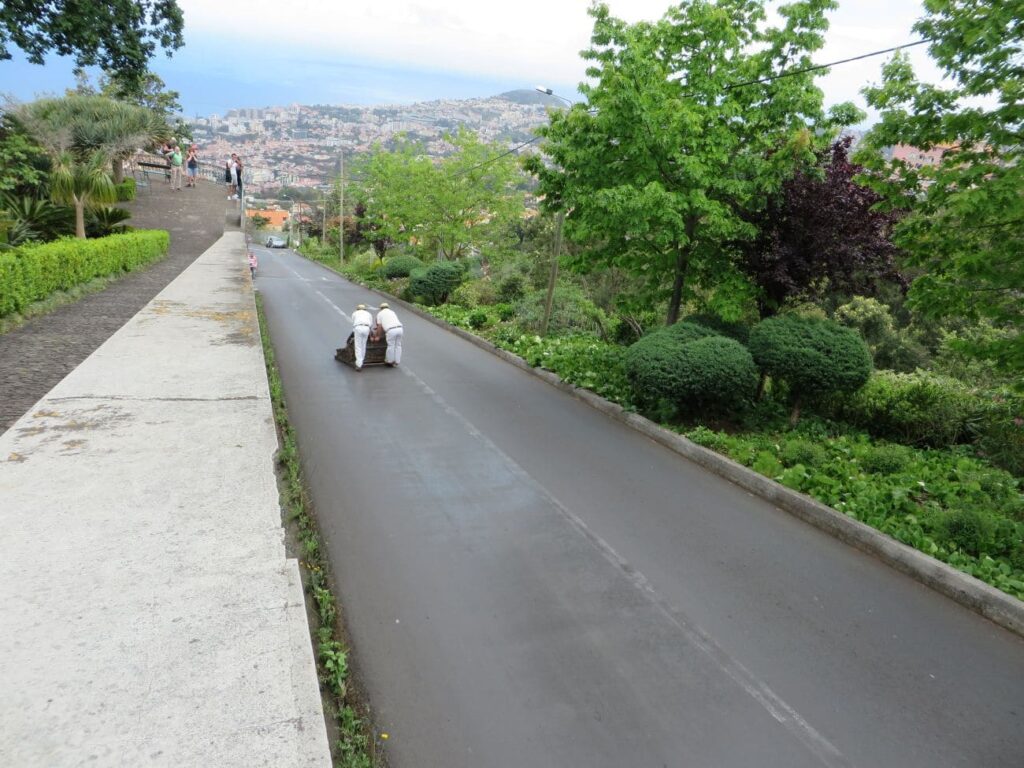
Descent in a carro de cesto guided by the Carreiros do Monte
From Monte, it is possible to make part of the journey back towards Funchal aboard a carro de cesto, one of Madeira’s most distinctive traditions.
These large wicker-and-wood sledges are steered by the carreiros, the white-clad men who guide them down the steep streets of the hillside using experience, balance and, most importantly, their boots.
Their history began long before the tourists arrived. Before becoming one of the island’s best-known attractions, the carros de cesto were used by the inhabitants of Monte as a practical means of reaching Funchal more quickly.
With this reassuring historical background established, it is time to sit down. You settle into a wicker-and-wood basket, contemplate the gradient of the road and acknowledge that, at some point, somebody considered combining these three things to be an entirely reasonable idea.
Then the carreiros push off and the basket gathers speed. At this stage, any further consideration of the wisdom of the arrangement becomes largely academic. The two men run alongside, brake with their boots, shift the weight of the basket and negotiate the bends with a precision that quickly turns initial suspicion into admiration.
There is very little improvisation in their movements. Every application of the brakes and every change of direction belongs to a technique refined by generations of carreiros. What initially looks like an improbable arrangement of wicker, wood, gravity and footwear soon reveals itself as an extraordinarily controlled performance.
Monte Palace Tropical Garden: a botanical collection above Funchal
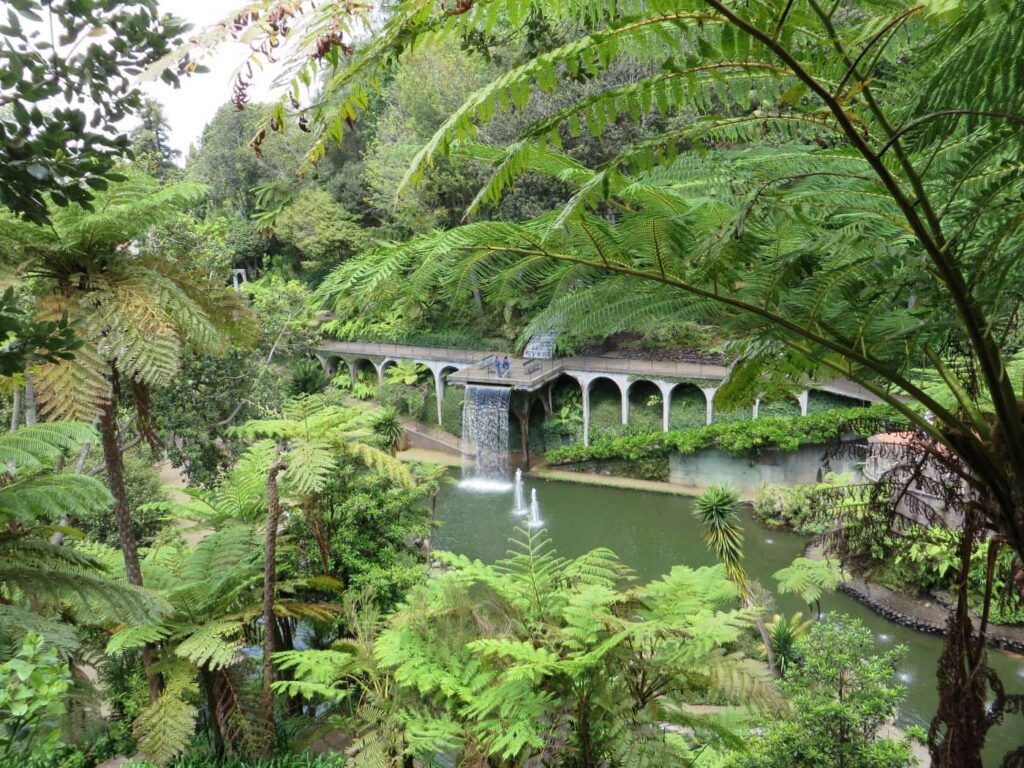
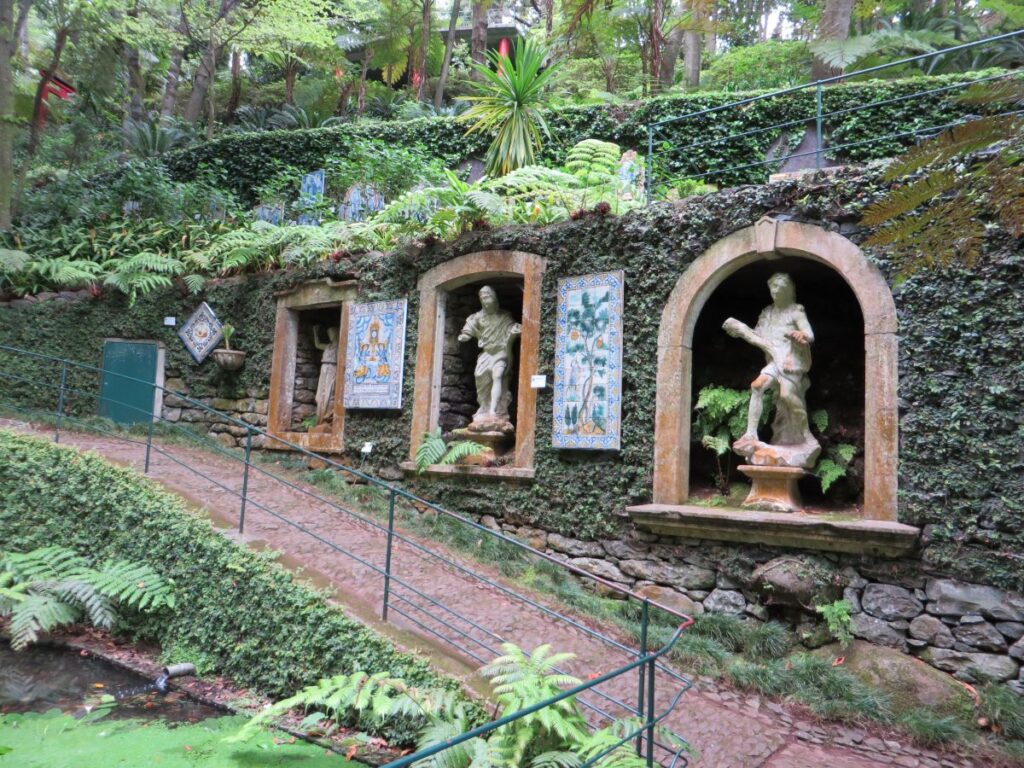
Monte Palace Garden in Madeira
The Monte Palace Tropical Garden occupies a historic Portuguese quinta in the hills above Funchal, reinterpreting the tradition of the great collection gardens, where botanical specimens, architecture and objects from distant cultures were brought together within a single landscape.
The paths wind past lakes and waterfalls, botanical collections, panels of azulejos and works of art. Tropical species grow alongside plants native to the archipelago, in a garden where botany, history and artistic collecting continually overlap.
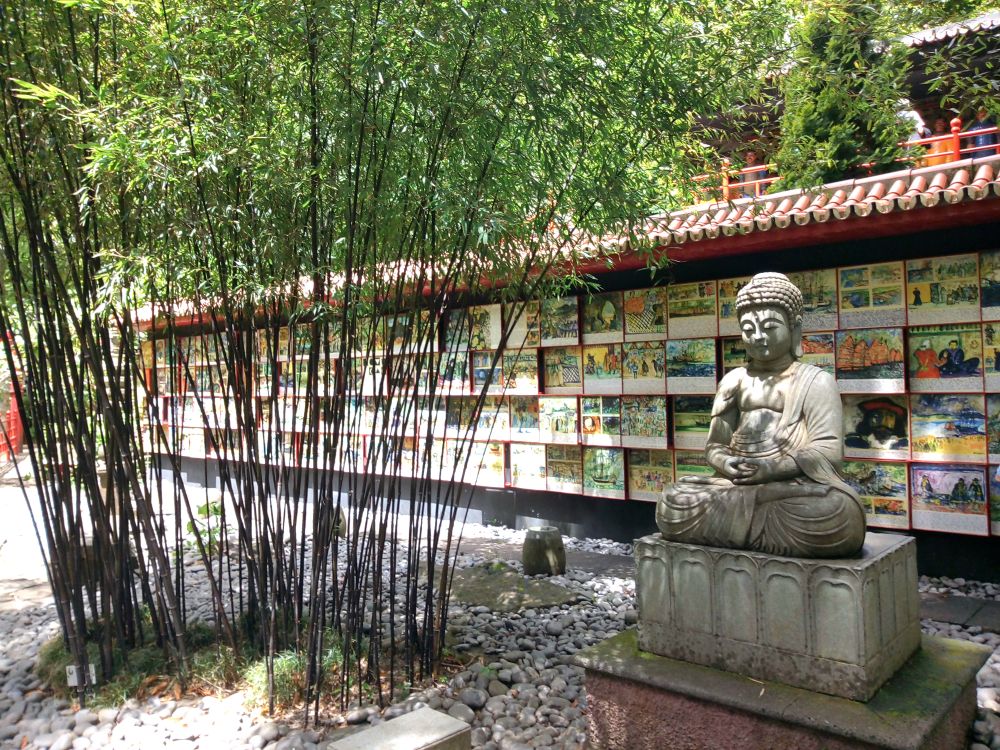
Among the more unexpected features of Monte Palace is its remarkable collection of Asian sculpture, scattered throughout the grounds with surprising discretion. Buddhas, stone lanterns, symbolic figures and decorative elements inspired by Chinese and Japanese traditions appear among tree ferns, bamboo and pools of water. At times, a figure emerges almost unnoticed from the vegetation; elsewhere, an entire composition opens unexpectedly beyond a bend in the path.
Porto Moniz and Madeira’s Natural Pools
Leaving Funchal and heading towards the north-west coast, Madeira changes character with remarkable speed. The road cuts through densely wooded mountains, deep valleys and tunnels bored into the rock, passing small settlements clinging to the slopes, where almost every cultivable patch of ground seems to have been wrested from the mountain.
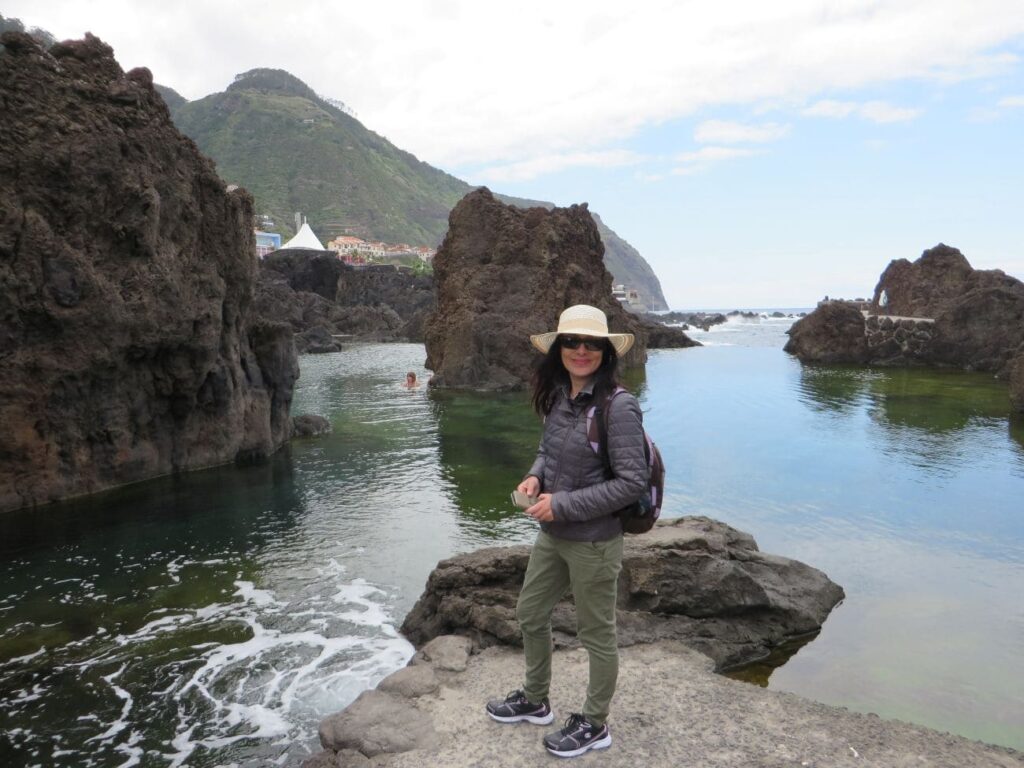
At Porto Moniz, the landscape suddenly opens onto the Atlantic and the island’s famous volcanic natural pools.
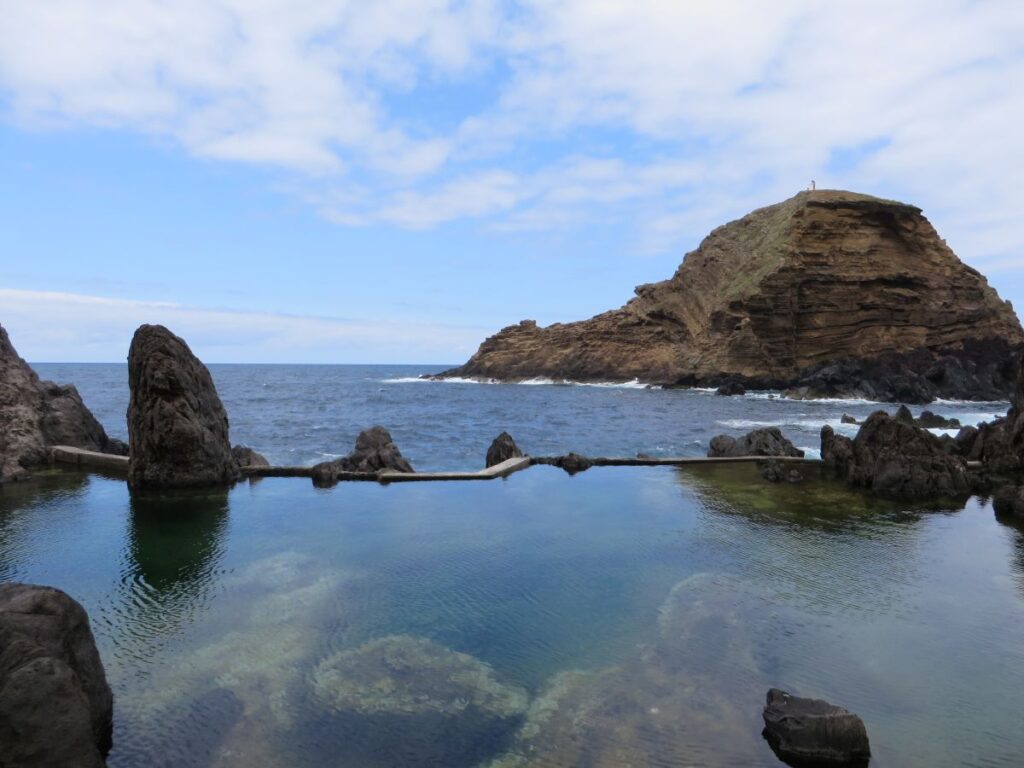
The pools occupy natural basins formed by the ancient lava flows that shaped Madeira’s coastline. Atlantic water enters through gaps in the volcanic rock and is continually renewed by the movement of the sea. There is something rather extraordinary about swimming here: the same black lava that once reached the ocean in a state of considerable violence now forms the walls of a bathing pool.
Unfortunately, the day I visited, Madeira had arranged rather less persuasive conditions for bathing. Clouds had settled over the coast and occasional rain completed the meteorological argument against removing one’s clothes. The pools were almost entirely empty, apart from two swimmers who appeared either remarkably resistant to cold or simply unwilling to admit that they had made a mistake.
When the sea is calm, the pools can seem almost deceptively tranquil. Then a larger wave arrives, spills over the black rocks and, for a few seconds, the distinction between swimming pool and Atlantic Ocean disappears altogether.
Madeira’s levadas: following the journey of water
In Madeira, water had to learn how to travel.
Rainfall is particularly abundant in the mountains and on the northern side of the island, while many cultivated areas lie along the drier southern coast. From the fifteenth century onwards, an intricate network of channels was therefore constructed to carry water for miles across slopes, rock faces and considerable changes in altitude.
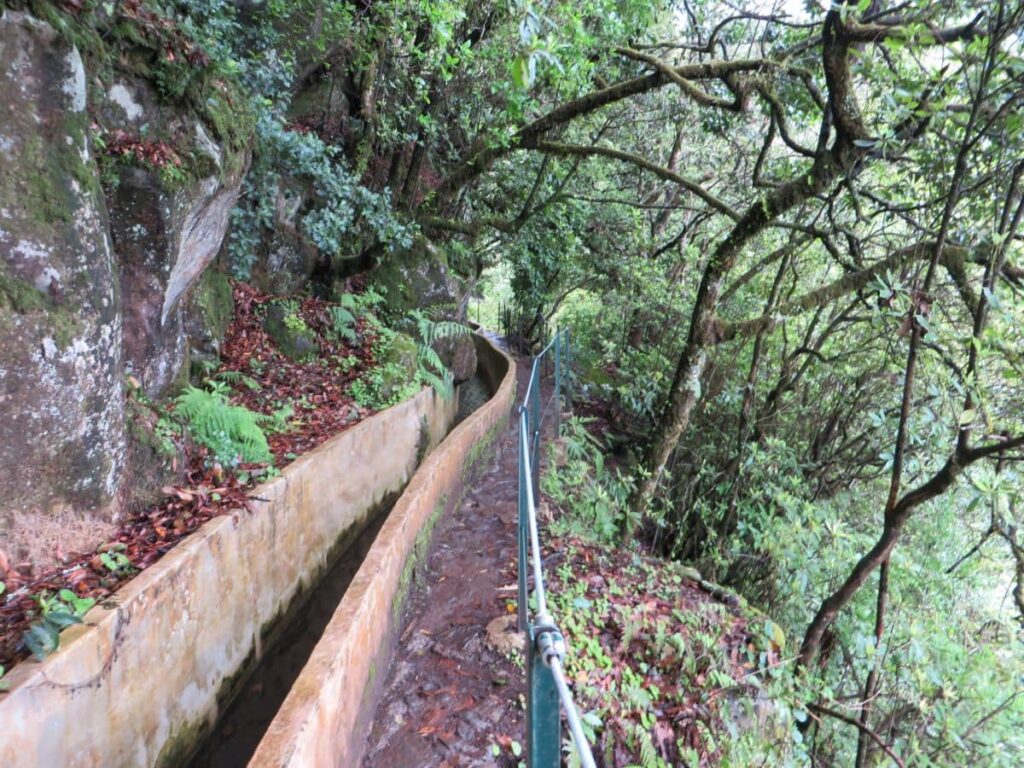
These were the levadas, the irrigation channels that still cross much of the island today.
Building them required an extraordinary amount of labour. Many sections were cut directly into the rock, often along precipitous slopes and in places that were extremely difficult to reach. Some levadas disappear into long tunnels through the mountains, where it takes very little imagination to appreciate quite how formidable their construction must have been.
For centuries, this network was essential for carrying water to cultivated land. Today, the paths running alongside the levadas have also become one of the most rewarding ways of exploring Madeira. They lead through laurissilva forest, deep valleys and volcanic landscapes, following routes in which the island’s natural and human histories are almost impossible to separate.
During one guided levada walk, however, I discovered a rather less spectacular — and perhaps more revealing — side of Madeira’s interior.
At one point, our bus made what was described as a “technical stop”. In the vocabulary of organised excursions, this is an admirably dignified expression for a considerably more practical requirement: finding a loo.
We stopped in a small mountain village and, while the rest of the group took a short break, I wandered into a little shop for no particular reason. I emerged with a small bag of Madeiran honey sweets.
I had bought them almost absent-mindedly, expecting very little. Yet a few days later, that simple taste brought back the woods we had walked through and that brief, unscheduled moment in the mountains. Curiously, travel sometimes works like that. The celebrated view may end up among hundreds of photographs, while a packet of honey sweets bought during a lavatory stop acquires the persistence of a madeleine.
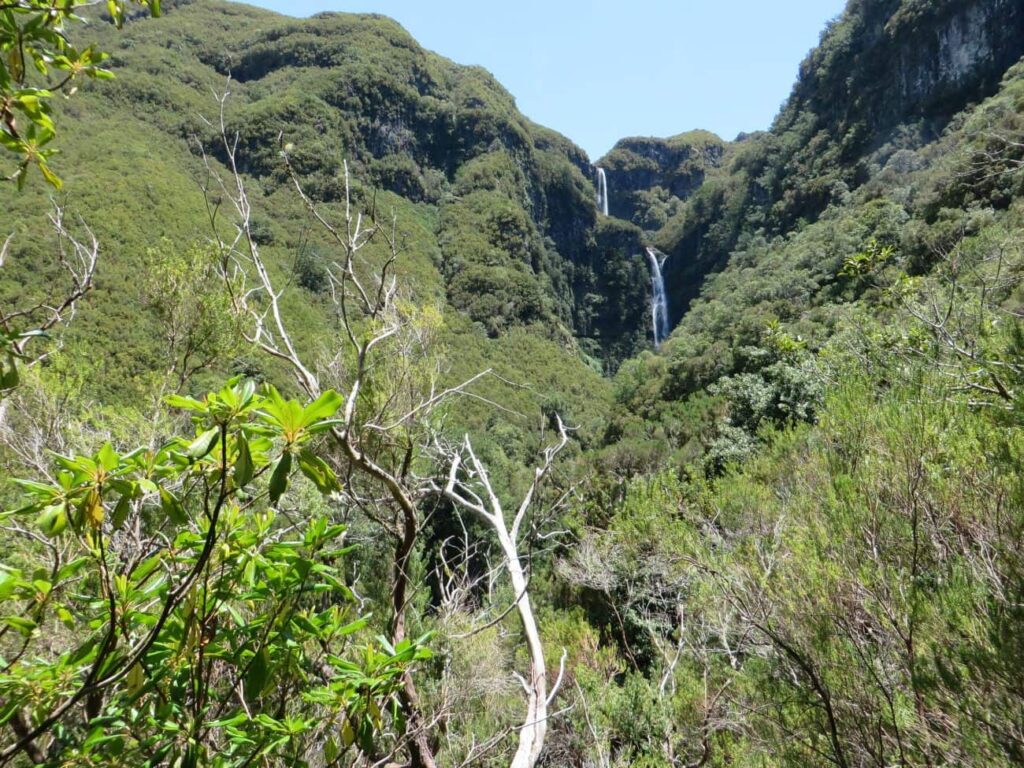
Risco Waterfall along the Levada das 25 Fontes
During my stay in Madeira, I followed several levadas, and no two ever seemed quite alike. Some ran beneath the shade of the laurissilva, between ferns and walls thick with vegetation; others crossed cultivated landscapes, where the water still continues its journey towards the fields; others opened onto broader views of the mountains and the coast.
Three in particular remain among my fondest memories of Madeira.
Levada das 25 Fontes: where water takes centre stage
The Levada das 25 Fontes is probably one of Madeira’s best-known walks. The route lies in the Rabaçal area, where the presence of the laurissilva is particularly striking and the landscape seems to have been designed almost entirely around water.
Its name comes from the numerous springs that emerge from the rock face at the end of the trail. Water trickles and falls from different points in the cliff, forming a series of small cascades before collecting in a natural pool enclosed by vegetation. After following water through the forest for much of the walk, you eventually arrive at a place where it has quite literally taken over the scenery.
Levada do Caldeirão Verde: into the mountain
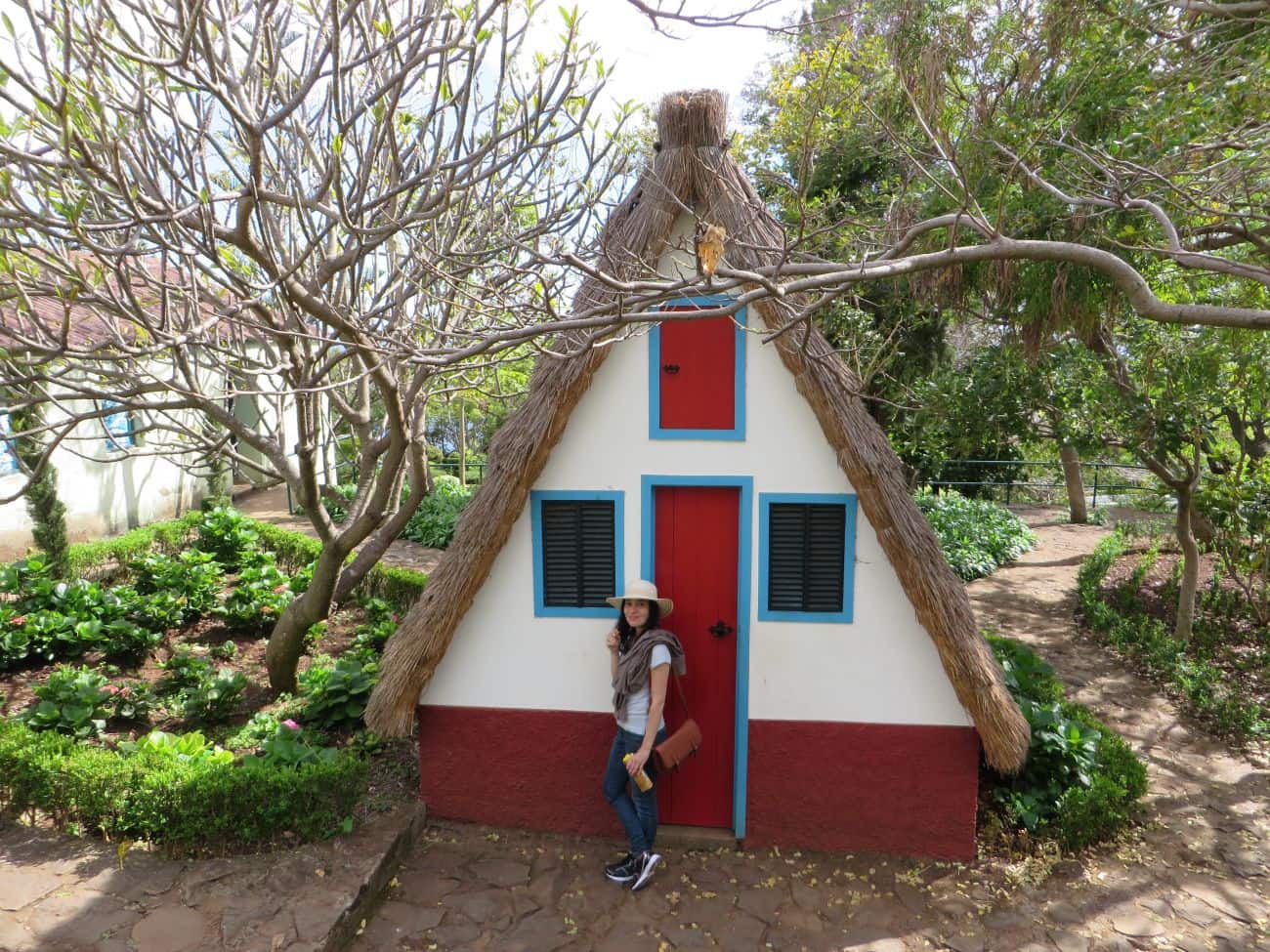
The Levada do Caldeirão Verde is one of the island’s most dramatic walks. It begins at Queimadas Forest Park, where one of the characteristic casas de Santana — the traditional houses with their steep triangular roofs — stands at the edge of the forest, before the trail continues into the laurissilva.
Here the mountains become more imposing. The path follows the rock face, crosses four tunnels cut through the mountain and eventually reaches the pool of Caldeirão Verde, fed by a waterfall dropping from a height of around one hundred metres.
The tunnels alter the character of the walk completely. One moment you are surrounded by vegetation and running water; the next, you are inside the mountain itself, torch in hand, progressing through darkness towards a small patch of daylight at the other end. Madeira, apparently, saw no particular reason why a walking path should remain outside a mountain.
Levada do Furado: Madeira from the inside
The Levada do Furado follows one of the island’s oldest public levadas. Beginning at Ribeiro Frio, the route passes through one of the most interesting areas of laurissilva, among characteristic species such as til (Ocotea foetens), vinhático (Persea indica) and Canary laurel (Laurus novocanariensis).
Compared with the other walks, however, this levada gradually offers a broader understanding of the landscape. Openings in the forest reveal the cultivated valleys of Faial, São Roque do Faial and Porto da Cruz, with the great mass of Penha d’Águia rising beyond them.
Perhaps more than any of the other routes I walked, the Levada do Furado reveals how Madeira is put together: forest covering the mountains, cultivated terraces descending the slopes and the Atlantic appearing beyond them, never entirely absent from the landscape.
Practical advice for walking Madeira’s levadas
For my levada walks, I chose to go with local guides leading small groups. It proved worthwhile for reasons that went well beyond simply finding the way. As we walked, I learnt more about the botany of the laurissilva, the formation of Madeira’s landscape and the history of the channels themselves. On some sections, having a guide was also reassuring, particularly where the path became narrower or more exposed.
Photographs of the levadas tend to show green forests, running water and mountains disappearing into mist, which is all perfectly accurate but not quite the whole story. These paths cross a volcanic landscape, where the ground can be uneven and conditions can change quickly. Some routes are perfectly manageable for less experienced walkers; others demand rather more attention, with tunnels, narrow sections and stretches where there is little or no protection from the drop beside the path.
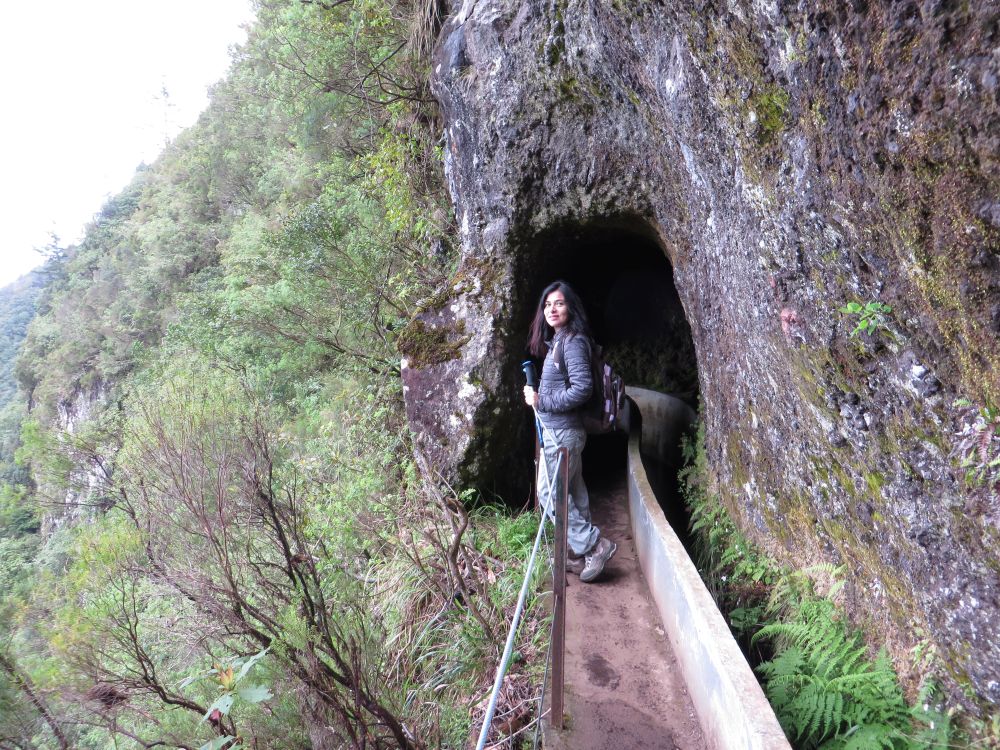
In places, the path may be little more than half a metre wide, with steep slopes or deep valleys immediately beside it. Anyone who suffers from vertigo should therefore check the route carefully before setting out. It is always worth looking at the length, difficulty and current condition of the trail in advance.
What to take with you:
- walking boots or sturdy hiking shoes with good grip, as some sections can be wet, muddy or slippery;
- a comfortable, lightweight rucksack, preferably with a rain cover or waterproof bag to protect anything that needs to stay dry;
- a waterproof or windproof jacket, even in summer: conditions in the mountains can change quickly and some areas are frequently shrouded in mist;
- a torch or head torch, essential for the tunnels encountered on some of the longer levada walks;
- water and a few snacks, particularly on longer routes where there may be nowhere to buy food or drink;
- sun protection and a hat, as UV exposure can still be significant when the sky is overcast;
- layers of clothing, so that you can adapt to changes in temperature between the coast and the mountains;
- a fully charged phone or power bank, useful for navigation, photographs and emergencies;
- a small first-aid kit with plasters and a few basic essentials.
Before setting out, always check the current status of the route. In Madeira, levadas and walking trails may be temporarily closed because of maintenance work, rockfalls or adverse weather conditions.
Madeira’s Laurissilva: a surviving fragment of an ancient forest
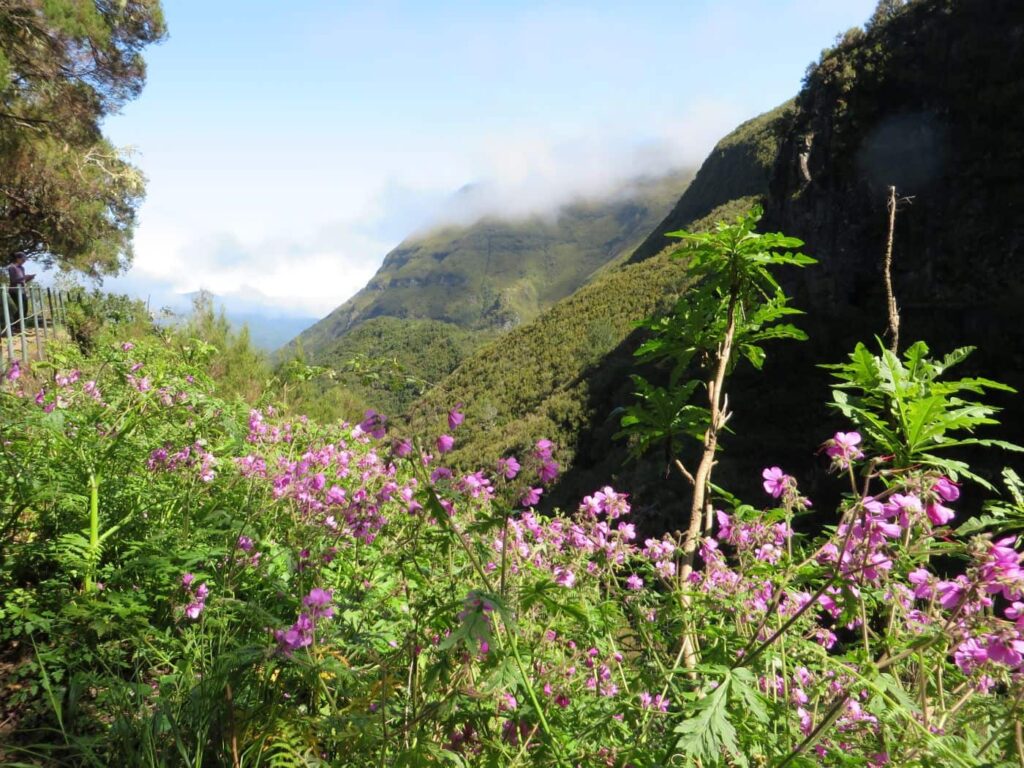
Along some of the levadas, the landscape changes almost imperceptibly. The human presence, marked by channels built to carry water across the mountains, gradually gives way to something far older: the laurissilva, Madeira’s remarkable native forest, inscribed on the UNESCO World Heritage List in 1999.
The forest is a kind of botanical memory. Millions of years ago, during the Tertiary period, forests of this type were widespread across parts of southern Europe, under climatic conditions very different from those of today. As the climate changed, they largely disappeared from continental Europe, surviving principally on the islands of Macaronesia. Madeira now preserves the largest surviving area of primary laurel forest.
The word laurissilva means laurel forest, a reference to the evergreen, laurel-like foliage characteristic of many of its trees. Yet this is far more complex than a woodland filled with laurels. It is an ancient ecosystem containing species found nowhere else, shaped by an environment in which humidity, mist and water are not occasional visitors but part of the forest’s everyday existence.
Among its characteristic trees are til (Ocotea foetens), vinhático (Persea indica) and Canary laurel (Laurus novocanariensis). Beneath their canopy, ferns, mosses and lichens flourish in the moisture held almost constantly in the air and soil.
The laurissilva has also played a fundamental role in Madeira’s human history. Its vegetation helps capture and retain moisture in the mountains, feeding springs and streams that have long provided essential water for agriculture. The levadas grew out of precisely this necessity: to collect that water and carry it across an island where cultivation often meant wresting usable ground from steep slopes.
Walking beneath these trees reveals a relationship that has endured for centuries. The forest gathers the water; the levadas carry it; and below, on slopes painstakingly turned into fields and terraces, people have learnt to make use of both. In Madeira, the boundary between natural history and human history is rarely as clear as it first appears.
Ponta de São Lourenço: Madeira shaped by the wind
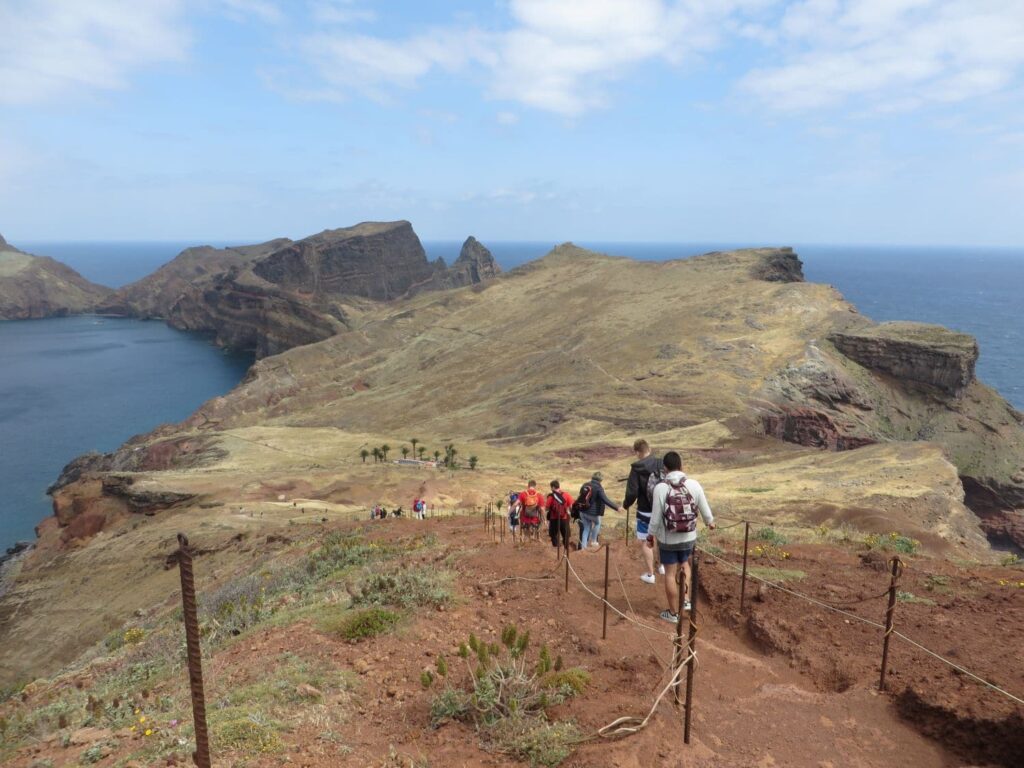
Volcanic cliffs and landscapes at Ponta de São Lourenço
After the deep green of the laurissilva and the cultivated slopes of the interior, Madeira’s easternmost tip seems to belong to a different island altogether.
Ponta de São Lourenço is a volcanic peninsula stretching out into the Atlantic at the eastern end of Madeira. Here, some of the island’s oldest rock formations are exposed, dating from the early stages of its volcanic history and subsequently sculpted by wind, rain and the relentless action of the sea.
Compared with the rest of Madeira, this is a considerably drier landscape. Rainfall is lower and exposure to Atlantic winds is almost constant. The vegetation reflects these conditions: the humid forest of the interior disappears, replaced by low, resilient plants adapted to limited water and the gusts sweeping in from the ocean.
This, at least, is the climatic theory. On the day I visited, Ponta de São Lourenço appeared determined to provide peer-reviewed evidence to the contrary. Rain arrived, the wind came in enthusiastic gusts and the sky showed no particular interest in cooperating. I had apparently managed to visit one of Madeira’s driest corners on a day when it had temporarily reconsidered its principles.
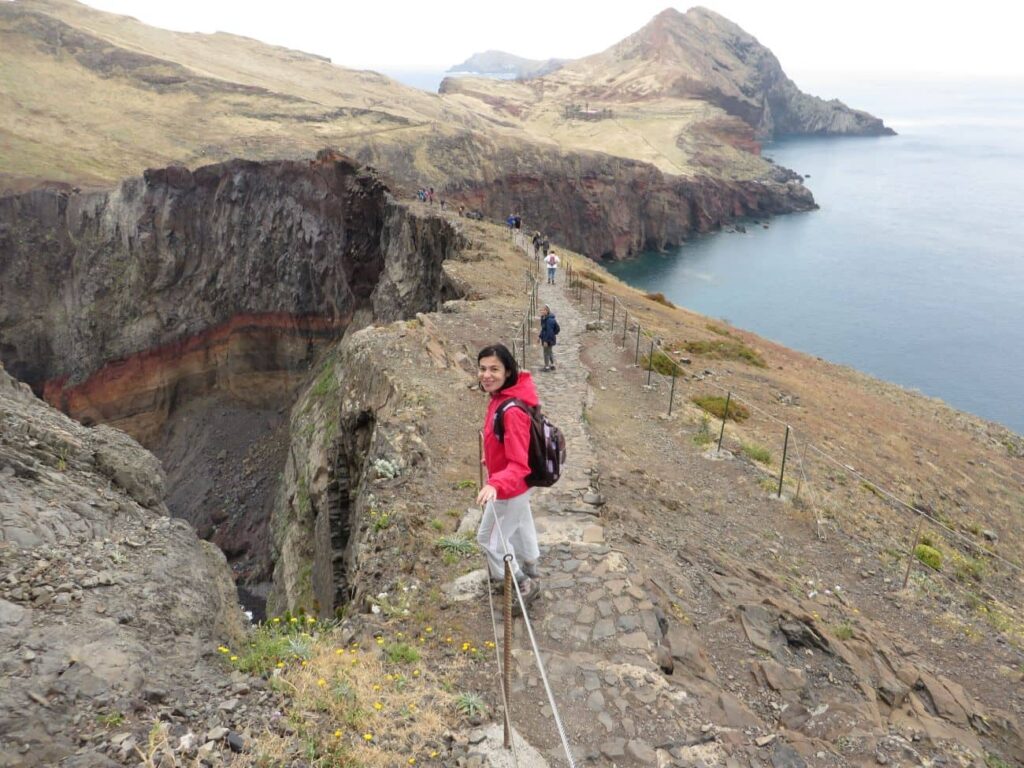
As the path continues towards the end of the peninsula, Madeira’s volcanic origins become increasingly difficult to ignore. Vegetation gives way to bare rock, while exposed layers of volcanic material reveal something of the long geological history beneath the island’s surface. With the Atlantic on either side, there is very little here to distract from the fact that Madeira began as a geological event in the middle of an ocean.
The Ponta de São Lourenço trail is not particularly difficult from a technical point of view, but some sections require care. The path narrows in places and there are exposed stretches with little or no protection from the steep drops beside it; strong winds can make these sections considerably more demanding. Anyone who suffers from vertigo, or simply feels uncomfortable on exposed paths, should take this into account before setting out.
Madeira’s villages between sea and mountains
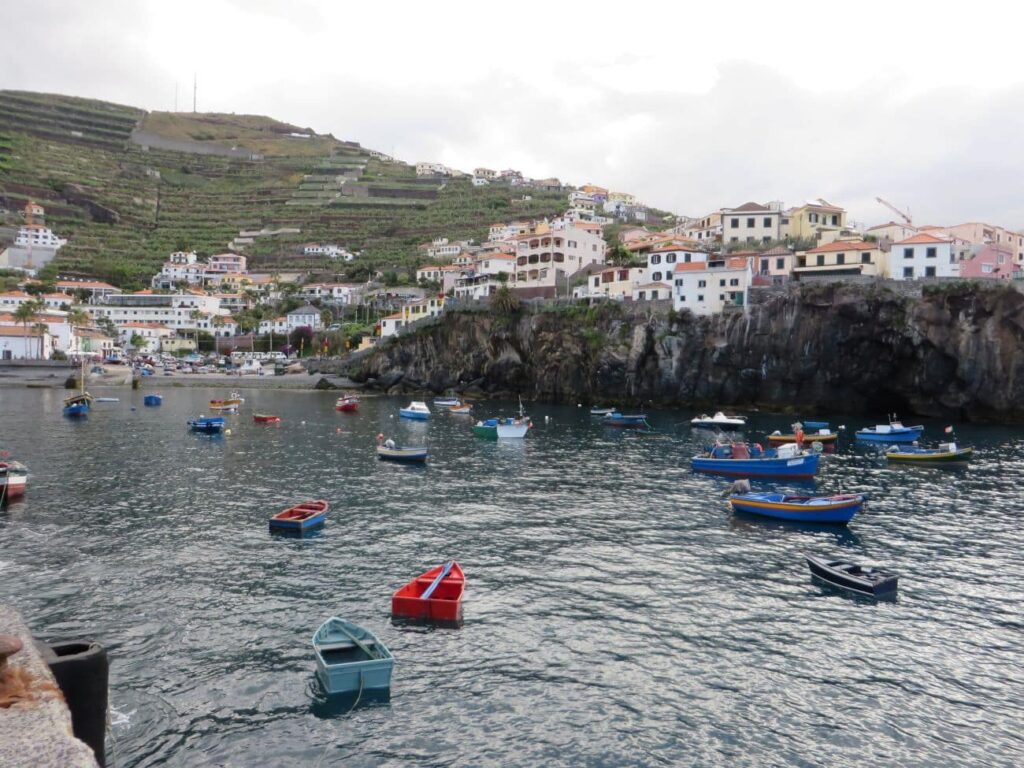
Câmara de Lobos harbour in Madeira
Beyond Madeira’s great natural landscapes are places where everyday life still follows the dictates of geography. Villages have grown in improbable spaces: small bays open to the Atlantic, valleys enclosed by volcanic walls and slopes laboriously transformed into cultivated terraces.
Câmara de Lobos, Curral das Freiras and Santana occupy three very different Madeiran settings: a fishing harbour on the south coast, a village enclosed by the mountains of the interior, and the traditional thatched houses of the north.
Câmara de Lobos: the harbour painted by Churchill
A few kilometres from Funchal lies Câmara de Lobos, an old fishing village gathered around a small bay.
The harbour still preserves something of the character of the original settlement. Colourful fishing boats cluster close to the shore, nets are tended along the quays and houses rise around the water, with the steep Madeiran landscape immediately behind them.
The bay also caught the attention of Winston Churchill, who came here to paint during his stay in Madeira in 1950. After spending much of his life concerning himself with matters such as wars, governments and the fate of Europe, Churchill found himself confronted with a problem of an altogether different order: whether the Atlantic required cobalt blue or ultramarine. Considerably less urgent than the fate of Europe, certainly, but a decision had to be made.
Curral das Freiras: the Valley of the Nuns
To reach Curral das Freiras, one leaves the coast and heads into Madeira’s mountainous interior, entering a deep valley enclosed by peaks that appear to shut it off on almost every side.
Its name means “Nuns’ Valley”, and its association with the nuns of Funchal’s Santa Clara convent dates back centuries. According to the best-known tradition, members of the community sought refuge here during corsair attacks in the sixteenth century. The story is an appealing one, although the connection between the valley and the convent also had a more prosaic foundation: the nuns already owned land here.
Arriving in the village, there is an immediate sense that almost every usable metre has had to be negotiated with the mountains. Rock walls rise steeply around the settlement, leaving remarkably little level ground on which to build or cultivate.
The inhabitants responded by making use of whatever the geography was prepared to concede. Fields follow the slopes, terraces trace lines across the valley and roads find their way through the rock wherever passage is possible. The result is not so much a village placed within a landscape as one constructed in continuous negotiation with it.
Curral das Freiras is also known for its chestnuts, an unexpected sight for anyone whose idea of Madeira begins and ends with subtropical vegetation. The altitude and microclimate of the valley favour chestnut trees, and their fruit has become an important part of local food traditions.
Chestnuts appear in cakes, liqueurs and other local specialities and are celebrated during the village’s annual chestnut festival. Here, agriculture follows a rather different calendar from that of the coast. Among volcanic walls, woodland and mountain cultivation, Madeira reveals a quieter, more seasonal character.
Santana and Madeira’s thatched houses
On the north coast, Santana is famous for its traditional houses with steep triangular roofs covered in thatch.
Santana was not part of my own itinerary, so I cannot offer the convenient fiction of having wandered among these houses myself. They are nevertheless worth mentioning because of their place in Madeira’s rural history.
Their distinctive form developed from thoroughly practical concerns. Timber available on the island was used in their construction, while the steep thatched roofs helped provide insulation and protection in the wetter climate of the north.
Today, the houses have become one of Madeira’s most recognisable symbols, reproduced on postcards, souvenirs and innumerable photographs. Their origins, however, are considerably less picturesque than their modern image suggests. They belonged to a rural world shaped by agricultural work, harvests, available materials and the continuing necessity of adapting human life to the island’s geography.
When to visit Madeira and how many days you need
When is the best time to visit Madeira?
It is one of the first questions to consider when planning a trip to the island, and the answer depends largely on what you intend to do once you arrive: walking, exploring the countryside and villages, swimming, or simply escaping the less accommodating climate of continental Europe for a few days.
Madeira enjoys mild temperatures throughout the year, but its geography creates a remarkable variety of microclimates. The difference between coast and mountains can be striking. You may leave Funchal in sunshine and, after gaining only a few hundred metres in altitude, find yourself surrounded by low cloud and wondering whether you have inadvertently travelled into another season.
Spring: Madeira in bloom
Spring brings a noticeable change to the island. Gardens, roadsides and mountain paths fill with new growth and flowers, while Madeira’s already exuberant vegetation becomes particularly difficult to ignore.
It is an especially rewarding season for gardens and walking, with mild temperatures and landscapes displaying much of the botanical variety for which the island is famous. The weather, however, remains Madeiran: conditions in the mountains may bear only a passing resemblance to those on the coast.
Summer: longer days and a more inviting Atlantic
Summer brings longer days and generally favourable conditions for walking, exploring villages and reaching Madeira’s viewpoints.
The Atlantic also reaches its highest temperatures of the year, although Madeira should not be mistaken for an island of endless sandy beaches and reliably placid water. This is a volcanic coast of natural pools, rocky bays and places where the Atlantic occasionally feels obliged to remind everyone that it is an ocean.
There are plenty of opportunities for swimming, but the experience remains distinctly Atlantic. Even in summer, the water is generally refreshing rather than tropical, reaching around 20–23°C during the warmer months and falling to lower temperatures in winter.
Autumn: softer light and fewer extremes
Autumn often brings very pleasant conditions, with temperatures that remain mild and a softer quality of light particularly suited to photography and long walks. As throughout the year, conditions can vary considerably between different parts of the island, especially between the coast and higher ground.
Winter: an escape from continental Europe
Winter remains an attractive option for anyone hoping to escape the colder temperatures of continental Europe. Madeira does not offer guaranteed sunshine — an important distinction in an island with mountains, Atlantic weather systems and a rather impressive collection of microclimates — but temperatures along the coast remain comparatively mild.
For walking, the practical question is often less whether it is “winter” or “summer” than what the weather is doing at the altitude and on the side of the island you intend to visit that particular day.
How many days do you need in Madeira?
For a first trip to Madeira, I would recommend at least five full days.
That gives you enough time to explore Funchal, visit some of the island’s viewpoints, reach Porto Moniz, walk one or two levadas and spend some time in the villages of the interior.
If, however, you want to explore Madeira without turning every day into an exercise in logistics, ten days or more is ideal.
Those extra days make an important difference. They mean not having to reduce the island to a list of places successfully ticked off before dinner. You can wait for a cloud to move away from a viewpoint, follow a secondary road simply because it disappears intriguingly into the mountains, linger in a village, or give another few hours to a walk that was never part of the original plan.
Madeira rewards a certain amount of flexibility — not because one must solemnly “slow down”, but because mountains, Atlantic weather and human curiosity are not always prepared to respect an itinerary.
Practical advice for visiting Madeira
Getting around Madeira
For the greatest freedom when exploring Madeira, a car remains the most practical option.
The island’s road network is considerably easier to navigate than it once was, thanks to tunnels, viaducts and modern infrastructure that have shortened many journeys. The geography, however, has declined to modernise. Mountains still rise abruptly behind the coast, and away from the main roads many routes continue to follow the contours of the landscape.
Distances on a map can therefore be deceptive. A journey of only a few miles may take longer than expected once gradients, bends and mountain roads become involved.
Public transport can be a useful alternative, particularly between Funchal and the island’s main towns and villages. Madeira’s bus network now operates within the SIGA system, bringing together Horários do Funchal, SIGA Rodoeste and CAM across the island.
For more isolated places, the starting points of some walks, or simply fitting several visits into the same day, however, a car is often the easier solution.
Another possibility is to join a small-group excursion with transport included. For several of my own trips I chose Secret Madeira, which offers guided walks and tours around the island. Minibuses and private transfers made reaching the beginning of the trails straightforward, while having a guide added considerably more than transport: I learnt about the botany of the laurissilva, the formation of the landscape and the history of the levadas. On some of the narrower or more exposed sections, being with someone who knew the route well was reassuring too.
One final piece of advice: resist the temptation to construct an itinerary in which every hour has already been spoken for. Distances in Madeira may be short, but mountains have a habit of interfering with arithmetic. Leave some room for unexpected stops, particularly at viewpoints, along secondary roads and in places you had not originally intended to visit.
Where to stay in Madeira
Choosing where to stay in Madeira is largely a question of deciding how much time you want to spend travelling around the island — and which side of it you would most like to experience.
For a first visit, Funchal is the most convenient base. It has the greatest concentration of restaurants and services, good transport connections and easy access to many excursions. In the evening, it also has the considerable advantage of allowing you to go out without automatically involving a car.
For somewhere quieter, Machico on the east coast and São Vicente in the north are both worth considering. Machico is well placed for exploring the eastern side of Madeira and is close to the airport, while São Vicente offers a much greener, more mountainous setting and a very different atmosphere from the south coast.
For a first stay, particularly if you would rather not change accommodation several times, it makes sense to choose a base that suits the places you actually intend to visit. Distances in Madeira are rarely enormous, but gradients, bends and mountain roads have their own opinions about journey times.
Article updated in August 2026.

No responses yet