
'/%3E%3C/svg%3E)


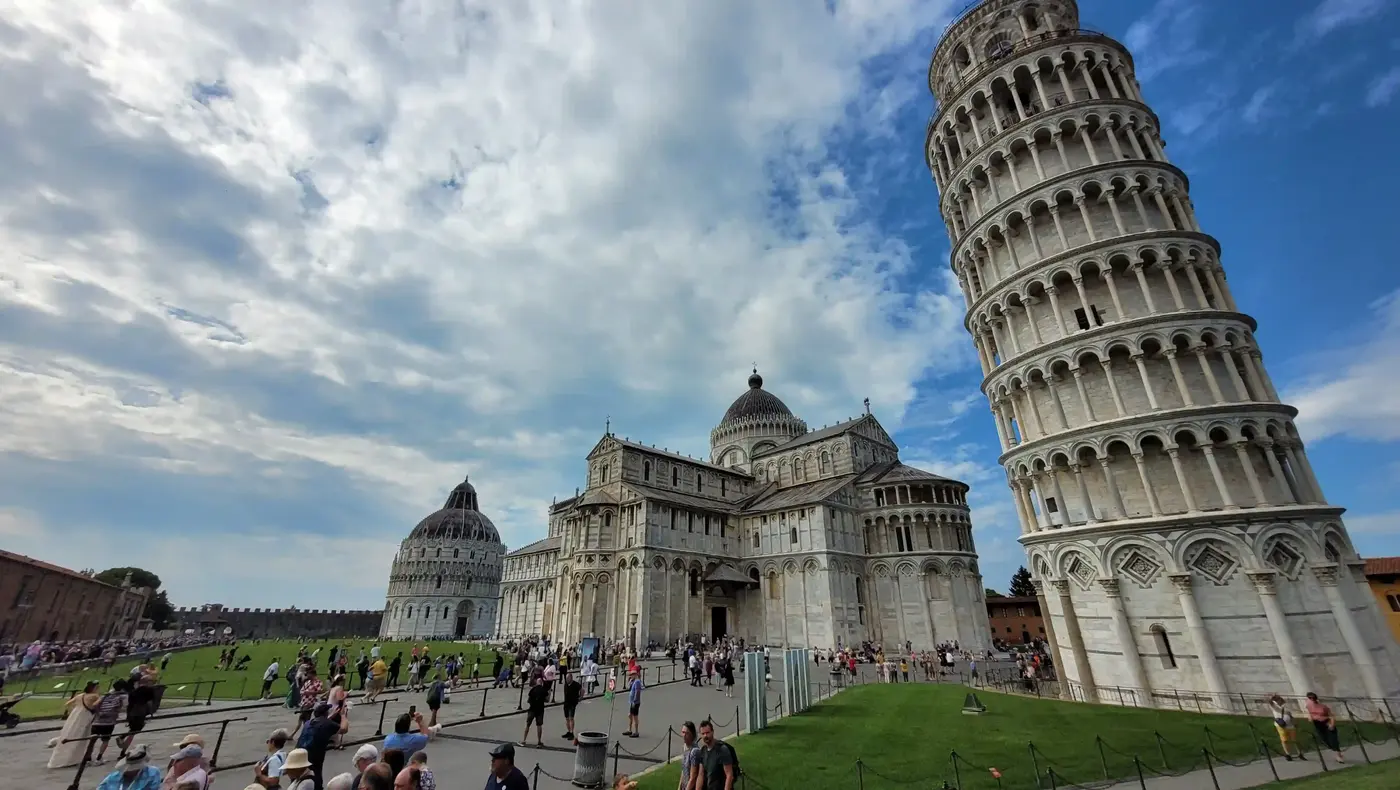
The Leaning Tower of Pisa possesses a rather unusual talent: it became famous because something went wrong.
In a world increasingly devoted to perfection, optimisation and the comforting illusion that every flaw can eventually be corrected, the Tower built its reputation on a structural problem.
A bell tower intended to rise proudly towards the heavens decided, somewhere along the way, to take a slightly different philosophical position.
And, rather wonderfully, humanity has spent centuries admiring it for precisely that.
Millions of visitors arrive in Pisa every year to see the famous campanile. Yet in the age of smartphones and social media, another curious ritual has developed around it: people from every corner of the planet attempting to restore the Tower’s balance using nothing more than an outstretched finger, careful positioning and someone else’s patience behind the camera.
A brief confession is unavoidable, partly for the sake of SEO and partly to prevent Yoast from appearing in my dreams brandishing its notorious red warning light: today we shall be discussing the Tower, Pisa, social media, photographs and tourists.
All together.
A combination that sounds rather like a digital Dadaist experiment designed by an algorithm that had enjoyed one glass too many, but which actually reveals something deeply human: our eternal desire to become part of the story, even when the story is a medieval bell tower politely refusing to move.
The Piazza dei Miracoli and the art of actually looking
I recently found myself in Pisa. More specifically, in the Piazza dei Miracoli, a name that might sound slightly theatrical were it not for the extraordinary concentration of beauty gathered within this small stretch of marble and grass.
Here stand the Cathedral, with the harmonious severity of Pisan Romanesque architecture; the Baptistery, whose remarkable acoustics transform stone into something almost musical; and the Camposanto Monumentale, a place where centuries of art, memory and human devotion coexist with remarkable dignity.
And then, of course, there is the Tower.
The famous leaning lady of Pisa has long since ceased to be merely an architectural curiosity. It is the monument that turned a structural miscalculation into a triumph of imagination, an unlikely symbol of beauty born from imperfection — the sort of paradox that history occasionally produces when nobody manages to correct the original mistake.
Yet, standing before such beauty, something rather curious happens.
Gradually, the Tower disappears.
Not physically, fortunately. After all, despite centuries of concern, it remains impressively committed to its position.
It disappears as an object of contemplation. Instead, it becomes a stage upon which every traveller can perform their own small act of photographic theatre.
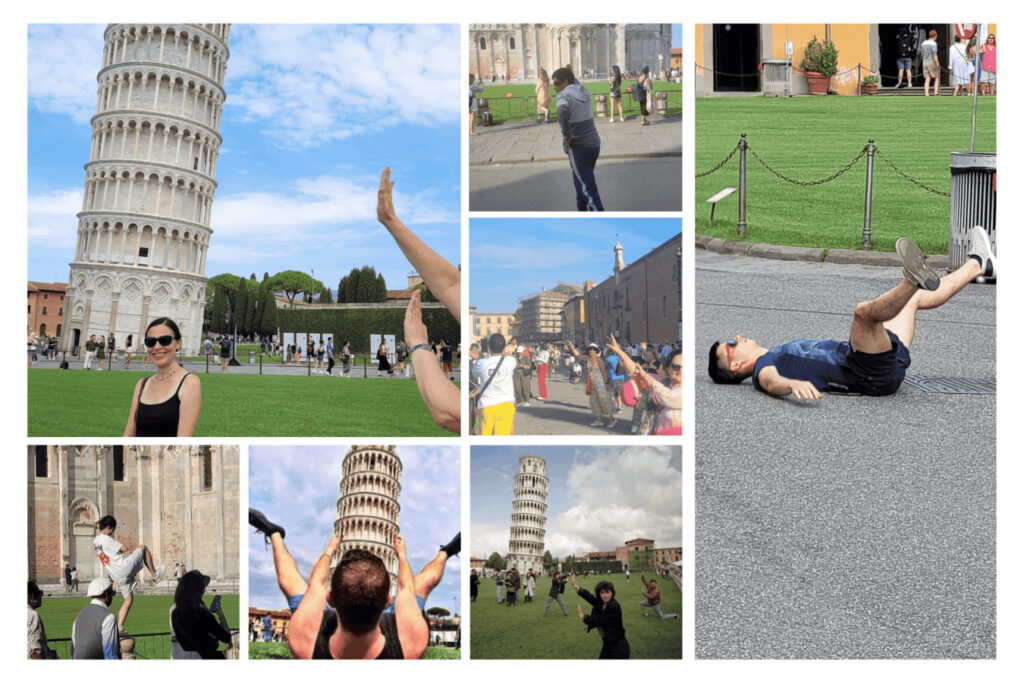
The photographer — usually an innocent member of the family who has been reluctantly promoted to the role of artistic director — begins the operation.
“Move slightly to the left.”
“No, too far.”
“Wait, it doesn’t look like you’re touching it.”
“One more.”
The family photographer discovers that they are no longer merely taking a holiday picture. They have become a specialist in visual effects.
The noble art of supporting what does not need support
The photographs created in front of the Tower now form a genre of their own.
There is the classic composition, in which two carefully positioned fingers bear the apparent responsibility of supporting several thousand tonnes of medieval marble. There is the athletic version: pushing the Tower away with a foot, as if it were an enormous football.
Others favour more imaginative interpretations, transforming it into an ice cream cone, a hat or any object that happens to reward a sufficiently optimistic understanding of perspective.
Visitors stroke it, embrace it and gesture solemnly towards it, as though attempting to establish diplomatic relations with an exceptionally patient monument. The Tower accepts all these attentions with admirable composure. Having survived unstable foundations, wars, restoration campaigns and several centuries of architectural concern, it seems entirely untroubled by the latest attempt to steady it with an outstretched index finger.
A quality perhaps worth admiring.
Among this cheerful theatre there exists, however, a more ambitious school of performers. These are the devoted practitioners of what might be called anatomical perspective: men and women who devote remarkable concentration to discovering the precise angle at which the Tower may appear to become an extension of their own physical magnificence.
The geometry involved is pursued with remarkable seriousness. Euclid, one suspects, might have raised an eyebrow.
The most memorable performance I witnessed belonged to a young man whose pose defied straightforward description. Bent forward with his hands planted firmly on the ground and his body arranged in a manner suggesting equal influences from gymnastics, contemporary dance and misplaced confidence, he appeared to be engaged in a form of symbolic courtship with the campanile itself. The resulting composition possessed the glorious, unsettling absurdity of a painting by Hieronymus Bosch, where saints, sinners, strange creatures and baffling human behaviour coexist without anyone appearing particularly surprised.
Bosch, I suspect, would have taken notes.
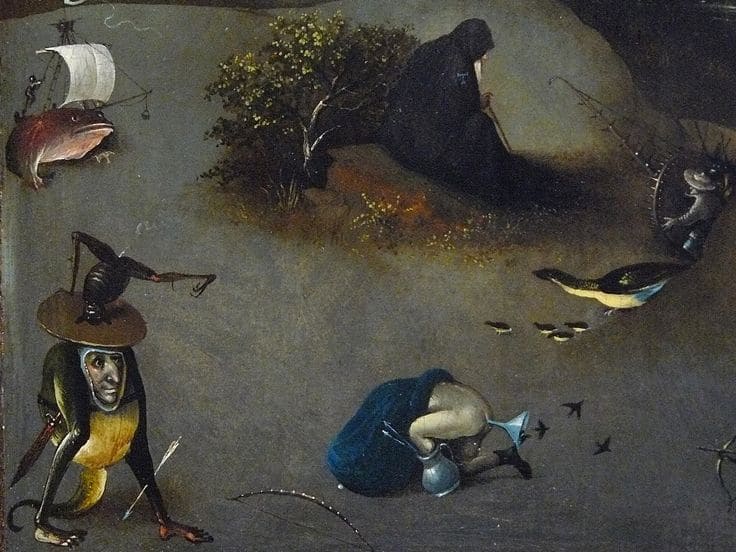
Detail from a painting by Hieronymus Bosch
When memory becomes performance
It would be unfair, of course, to declare war on every tourist armed with a smartphone. Travel has always involved a degree of playfulness, and some of the world’s most cherished holiday photographs are objectively ridiculous. Families have been standing in improbable poses in front of famous monuments long before Instagram arrived to document the evidence.
The difficulty begins when the photograph quietly takes the place of the experience.
Watching the scene unfold in Pisa, I found myself wondering how many people had actually looked at the Tower that day. Not photographed it, admired it through a screen or carefully aligned it with an outstretched finger, but simply looked at it. Really looked.
Because the Leaning Tower is far more than the world’s most obliging photographic prop. It is an extraordinary feat of medieval engineering, shaped as much by human error as by human ingenuity. Every arcade, every block of luminous Pisan marble and every subtle dialogue it holds with the Cathedral and the Baptistery tells a story of ambition, persistence and remarkable technical skill. None of that becomes less true simply because millions of people now encounter it through a mobile phone.
To be fair, social media has also changed travel for the better. It has rescued forgotten villages from obscurity, encouraged curiosity about places that rarely appeared in guidebooks and persuaded travellers to venture beyond the obvious. That is no small achievement.
What concerns me is something rather different.
A photograph is a splendid souvenir. It was never meant to become a substitute for seeing.
Seeing Pisa beyond the famous silhouette
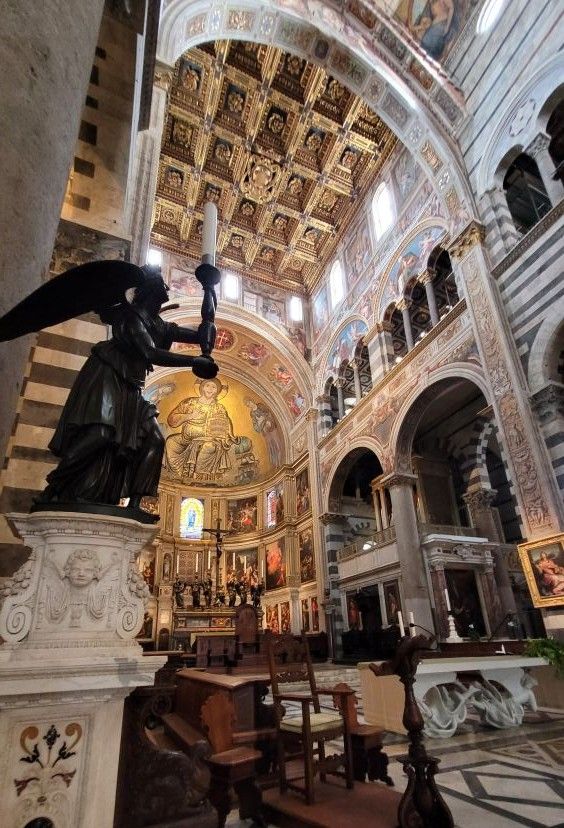
Interior of Pisa Cathedral.
So yes: visit the Leaning Tower of Pisa. Of course.
Ignoring it would be rather absurd. It has thoroughly earned its reputation, together with its curious modern destiny as the only medieval tower in the world that inspires millions of perfectly sensible people to attempt emergency structural intervention with a single index finger.
But once the photograph has been taken and the obilgatory Instagram moment has been secured, stay a little longer.
Walk into the Cathedral and allow your eyes to adjust to its extraordinary harmony of light, marble and proportion. Step inside the Baptistery and listen as architecture performs one of its oldest magic tricks, transforming stone into sound. Wander through the Camposanto Monumentale, where frescoes that have survived centuries of history—and even the devastation of war—still reward anyone willing to slow down.
There, perhaps, something important happens. The tourist becomes a traveller again.
The Tower, meanwhile, continues exactly as it always has: quietly leaning, magnificently unconcerned by our efforts to improve upon medieval engineering, and serving as a gentle reminder that not everything requires our assistance in order to remain standing.
Unlike, perhaps, SEO.
And before Yoast begins sharpening its red warning light, let me conclude with the necessary incantation:
Tower. Pisa. Social media. Photographs. Tourists.
There. We should all sleep rather better tonight.

No responses yet