


Confession time.
I am a travel blogger.
Not the sort with a polished media kit, a carefully curated colour palette, or a sponsorship proposal tucked discreetly into every email.
No airline has ever whisked me off on a press trip. No hotel has greeted me with a complimentary tote bag containing artisanal biscuits and a notebook bearing the inevitable inspirational slogan about wanderlust.
I have never received a backpack in exchange for “honest exposure,” which is probably just as well, because I have never trusted a backpack that arrived with contractual obligations.
I am, in every practical sense, an amateur—hopelessly so. And yet I am unmistakably a travel blogger, because I travel, because I write, and because I have spent years describing places not to persuade anyone else to visit them, but to understand why they mattered to me in the first place. Every journey redraws a small corner of my internal map, and maps, unlike social media feeds, have never benefited from being updated every five minutes.
There is, however, one small complication.
I never write about a trip when everyone expects me to.
Why I Never Write About a Trip Straight Away
The moment I return home, I become remarkably useless as a travel writer. My suitcase remains half-unpacked, my head is still somewhere between departures and arrivals, and the only thing I know for certain is that I have brought back either too many socks or not enough.
People are forever talking about capturing the moment. I prefer to let the moment wander off for a while. Only then does it become interesting.
I need silence. I need distance. Above all, I need that curious stretch of time in which photographs stop behaving like evidence and quietly transform themselves into memories. That is when the smallest details begin making unreasonable demands on my attention: the smell drifting from an anonymous bakery, half a sentence overheard on a tram, or the peculiar shade of green chosen for the bathroom tiles in an otherwise perfectly respectable hotel. Those are rarely the things anyone photographs, yet they are invariably the things that stay.
I’ve never understood how someone can write a thoughtful guide to Istanbul forty-eight hours after landing home, or declare themselves profoundly changed by a tiny village in Asturias while still sitting at the departure gate, anxiously watching their phone battery slip towards single digits. My memories are stubborn creatures. They refuse to speak until they’ve had time to settle, which means I require precisely the one thing modern social media appears to regard as an administrative inconvenience: time.
The Joy of Being Fashionably Late
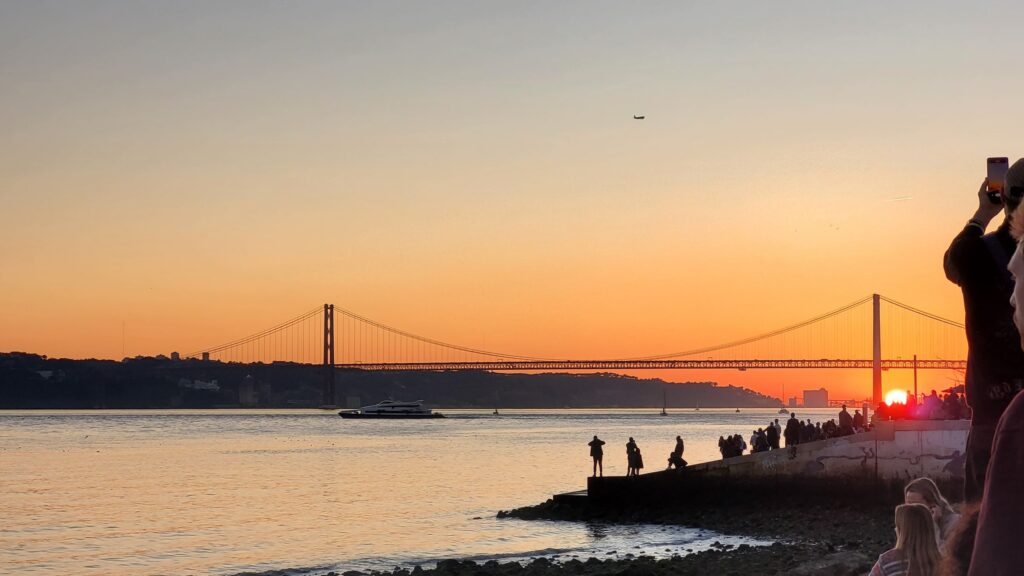
Sunset over the Tagus River in Lisbon, with the 25 de Abril Bridge in the background, creating a contemplative travel atmosphere.
This is why my photographs are frequently, unapologetically, out of sync.
Today I might publish a sunset from Lisbon. Tomorrow, a brightly painted staircase climbing towards the sky in Arzachena. Next week, perhaps a reflection drifting lazily across the Dordogne.
Without fail, someone will ask,
“Wait… are you in Portugal?”
Or, even more optimistically,
“Still travelling?”
As though posting a photograph must occur at exactly the same moment it was taken.
No. I’m not still travelling.
I’m simply running several years behind schedule.
It’s one of my better qualities.
Because I have absolutely no desire to become a prisoner of the present tense. I don’t want to narrate life while I’m busy living it. I don’t want to interrupt wonder simply to document it. I’d rather allow one memory to wander into another without asking permission. I’d rather notice that a sunset over the Tagus somehow reminds me of an evening in Rome years earlier, and sit with that thought until it grows into something worth writing.
Not every feeling needs to become a five-slide carousel before breakfast.
Slow Travel Writing in the Age of Instant Content
My travel writing resemble broth.
You begin with a few promising ingredients. You leave them alone. Eventually they discover how to speak to one another. Only after a respectable amount of simmering do you taste, adjust, remove what doesn’t belong, and decide whether the whole thing deserves to leave the kitchen.
I realise this is a slightly old-fashioned approach.
Possibly even suspicious.
We live in an age that rewards simultaneous narration. If you’re somewhere beautiful, you’re expected to prove it immediately. Better still, go live. Film yourself admiring the view while remembering to look into the camera.
If you wait until later, people begin behaving as though you’ve misplaced reality itself, as if delayed storytelling were evidence of deception rather than a deliberate creative choice.
Why I Refuse to Let the Algorithm Decide When I Tell My Story
People occasionally offer helpful advice.
“You’ll lose followers.”
“The algorithm won’t reward you.”
I usually nod politely. Then I continue exactly as before.
The algorithm, I’m sure, will cope.
To be fair, there are creators whose ability genuinely astonishes me. They arrive somewhere extraordinary, unpack a suitcase, edit a flawless video, publish it before dinner and somehow still remember to enjoy the holiday. I regard these people with the same admiration I reserve for concert pianists and anyone capable of folding a fitted sheet.
I simply do not possess that particular talent.
When I encounter something beautiful, my first instinct is simply to look. Properly. Only afterwards—sometimes much afterwards—do I begin to understand what I’ve seen.
Sometimes the real sentence doesn’t arrive until three weeks later while I’m washing the dishes and wondering why a particular doorway in Lisbon has suddenly reappeared in my mind as though it had merely stepped out for tea.
Why Slow Travel Writing Still Matters
For me, the time for storytelling has never been the time of experience.
So no, I won’t be posting from the airport lounge, editing reels between boarding announcements or announcing that a place has changed my life before I’ve even unpacked.
I’ll almost certainly tell you about it months later.
By then the crowds will have moved on, the algorithm will have forgotten me, and perhaps the journey will finally have had the good manners to explain itself.

No responses yet